
WPC Vs Wood Vs Plywood: Which Door Frame Should You Use In A Bathroom?
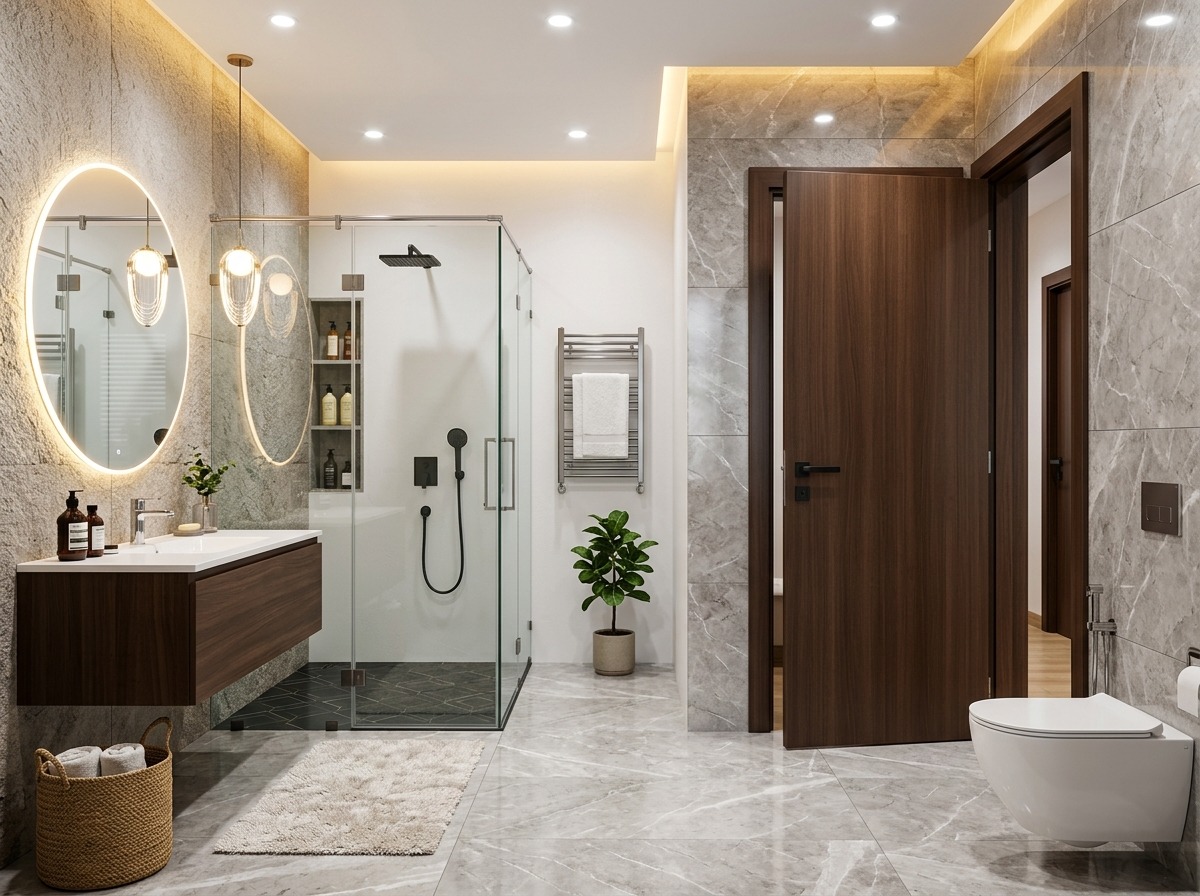
Most door frame complaints on Indian sites come from one place: the bathroom. The frame stands on a wet floor, water reaches the bottom 6 inches every day, and within a few years a wooden chaukhat is soft, black and full of termites. Plywood frames do not last much longer.
Side-by-side Comparison
| WPC | Solid wood | Plywood | |
|---|---|---|---|
| Water | Does not absorb water (0.2% in lab test) | Absorbs water, swells, rots at the bottom | Absorbs water at edges, layers open up |
| Termites & borers | Not affected | Needs chemical treatment, still at risk | Needs treatment, glue lines get attacked |
| Fire | Fire retardant, UL-94 V-0 in lab test | Burns | Burns |
| Straightness | Stays straight | Can bend or twist with moisture | Can warp if edges get wet |
| Finishing | Paint, polish or laminate | Paint or polish, needs repeat polishing | Needs lamination or edge banding |
| Carpentry | Cut, screw and nail with normal wood tools | Normal tools | Normal tools |
| Maintenance | None | Polish and termite treatment | Edge sealing, repairs |
WPC values from lab tests on Green Plastwood samples by Alekh Plastics Testing Centre, Ahmedabad (Nov 2022).
Where Each One Makes Sense
Bathrooms, Toilets And Kitchens
Use WPC. This is where wood and plywood fail first, and replacing a frame later means breaking tiles and plaster. A WPC frame does not absorb water, so the bottom of the frame stays the same as the top.
Main Door
If you want a heavy carved wooden door on the main entrance, a solid wood frame is still common. If the main door faces rain or is near a wet area, a high-density WPC frame (125 × 63 or 150 × 63 mm) is the safer choice.
Bedrooms And Living Rooms
Any of the three will work in a dry room. Many builders now use WPC across the whole flat so that every frame is the same size and colour and there are no termite issues later.
Hospitals, Schools And Hostels
Use WPC frames with WPC or 3 layer doors. These buildings are washed daily and doors take a lot of use. A 3 layer door has a rigid PVC skin on both faces, which handles knocks better.
Rule of thumb: if the frame will ever touch water, use WPC. It costs less than replacing a rotten wooden frame and redoing the tiles around it.
Common Questions
Can A Carpenter Work With WPC?
Yes. WPC is cut, drilled, screwed and nailed with the same tools used for wood. In our lab test, a Green Plastwood door frame held 2236 N of screw withdrawal force.
Can I Polish Or Paint It?
Yes. WPC frames take paint, polish and lamination. Our frames also come in 8 ready colours, so many sites skip polishing altogether.
Is WPC Eco-friendly?
WPC replaces timber, is 100% recyclable, and Green Plastwood products are formaldehyde and lead free.